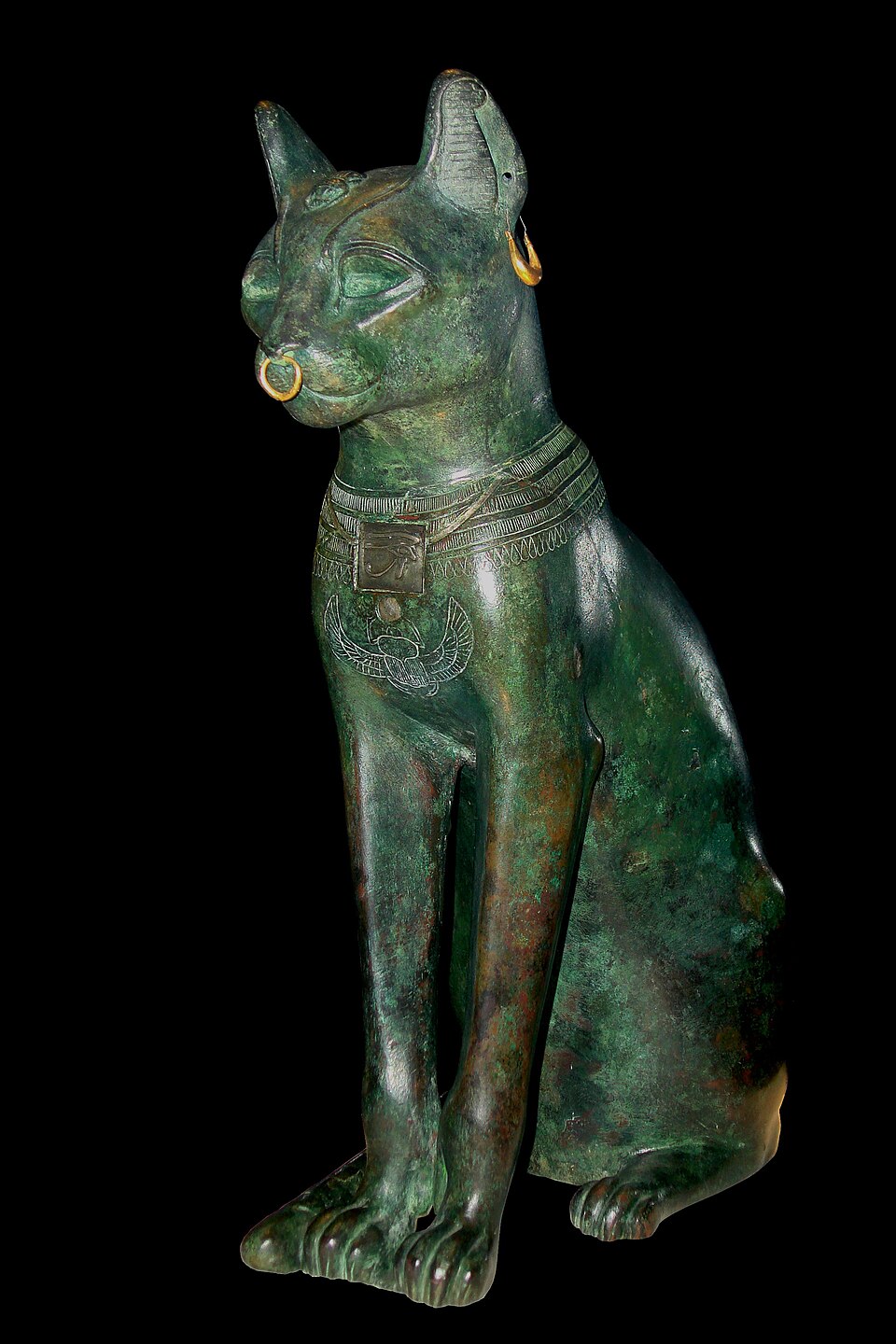
Bastet's Power Ritual
Heavenly Power of the Sistrum, Great Queen of All Powers, the Cat Goddess, She of Bubastis
Learn more… Ansuzx10
 Raidhox10Ansuzx10
O, Bubastis,
O, Heavenly Power of the Sistrum,
O, Great Queen of All Powers,
We, the Temple of Zeus Assembly, bless you and invoke you.
When you shake the Sesheshet, the pillars of heaven tremble with joy and the vile entities scatter like dust before the wind.
Come to us, O Radiant One, for we have kept your festival alive in our hearts.
 Thurisazx10Raidhox10Thurisazx10
Your Power is Felt, Visible, and Observable,
Your Power is always existing.
Silent as the cat that watches in the dark, swift as the lioness that strikes at dawn.
You are the Eye of Ra made gentle, the fire of the sun made warm.
In your tender form you guard the home; in your fierce form you guard the cosmos.
 Sowilox10
 Berkanox10
 Fehux10
Haagenti, Goddess of Many Names.
Blessed are we by you, Queen of Gods,
Immersed are We in your Spiritual Power.
Seven hundred thousand pilgrims once sailed the Nile to celebrate you at Bubastis,
And now we, though fewer in number, carry the same fire in our souls.
Your joy is not weakness; your joy is the strength that outlasts all sorrow.
 Uruzx10Ansuzx10
 Laguzx10
"Behold the Initiates of the Gods,
They are Eternally the Ones I love, the Ones I promote, the Ones I protect.
They bless my Name and love me, and I shall bless their Names with the power of Sesheshet."
And we receive your word with open hearts, O Mother of Joy,
For you do not merely protect the body: you protect the happiness within it, the laughter within the household, the love within the family.
 Tiwazx10Thurisazx10Tiwazx10
She pounces upon them with sharp nails and wrecks them.
The evil spell cast against the Temple of Zeus and its People has now backfired and returned to its creators entirely,
For Queen Bastet has made it so.
The mouths of the Yehuborim told the world to kill your sacred cats and shut your temples. But you cannot cage what is wild, and you cannot silence the sistrum that shakes in the hand of a Goddess.
 Kenazx10Berkanox10Ansuzx10
You have Many Names,
All of them are Blessed,
All of them are immersed in Zeus's Providence.
Blessed are you, Bastet!
The cat knows what the lion has forgotten, and the Goddess remembers what the world has been made to forget.
Your secret Name hums beneath all things: in the purr of contentment, in the roar of wrath, in the silence between them where power lives.
BLESSED IS HER POWER AND LIFE-FORCE,
BLESSED ARE WE THROUGH HER,
BLESSED AND THRICE BLESSED ETERNALLY!
After you are done with this, you can meditate on Bastet's Sigil in the Temple of Zeus, or the one below. Let yourself be immersed and receive energy from Bastet.
It's important to meditate on yourself after the Ritual calmly for a few minutes.
SAT
सत्: SAT, real, true, truthful in Sanskrit.
The Shen Ring
The Symbol that Encapsulates the Sigil: The Shen Ring, Egyptian Hieroglyphic language. The Shen also survived in Chinese tradition as a glyph for Spiritual Force, Divine Force, and God.
Letters of the Sigil
The Ancient Greek letters for Bastet's Name in arrangement.
On Bastet
Bastet (Egyptian: Bꜣstt) is the cat-headed Goddess of home, fertility, joy, music, dance, and protection. Her cult center at Bubastis (Tell Basta) in the eastern Nile Delta was one of the most celebrated in Egypt. Herodotus (Histories II.59-60) describes the annual Festival of Bastet at Bubastis as the largest and most joyous religious gathering in Egypt, attended by 700,000 pilgrims. Originally depicted as a fierce lioness (an aspect later differentiated as Sekhmet), Bastet evolved into the more gentle cat-form from the New Kingdom onward. The Sesheshet (sistrum) is her sacred instrument: its rattling sound was believed to drive away evil spirits and invoke divine joy. Her name may derive from bꜣs ("fire, heat") + the feminine suffix -t, connecting her to the protective fire of the Eye of Ra.
(Sources: Herodotus, Histories II.59-60, II.137-138; Wilkinson, The Complete Gods and Goddesses of Ancient Egypt, 2003; Malek, The Cat in Ancient Egypt, 1993)
On Haagenti (Goetic #48)
The Goetia lists Haagenti as the forty-eighth spirit: a President commanding 33 legions, appearing as a bull with griffin wings. His attributed powers (transmuting metals into gold, turning water into wine, conferring wisdom) correspond to Bastet's transformative role: the Goddess who transmutes the base energies of the soul (fear, grief, anger) into their refined forms (courage, joy, love). The bull-form in the Goetia may preserve the memory of the Apis bull, sacred to Ptah at nearby Memphis, with whom the Bubastis cult had close connections. The name Haagenti may derive from a corruption of Ha-Bastet ("the house/spirit of Bastet").
(Sources: Weyer, Pseudomonarchia Daemonum, 1577; Ars Goetia, 17th c.)