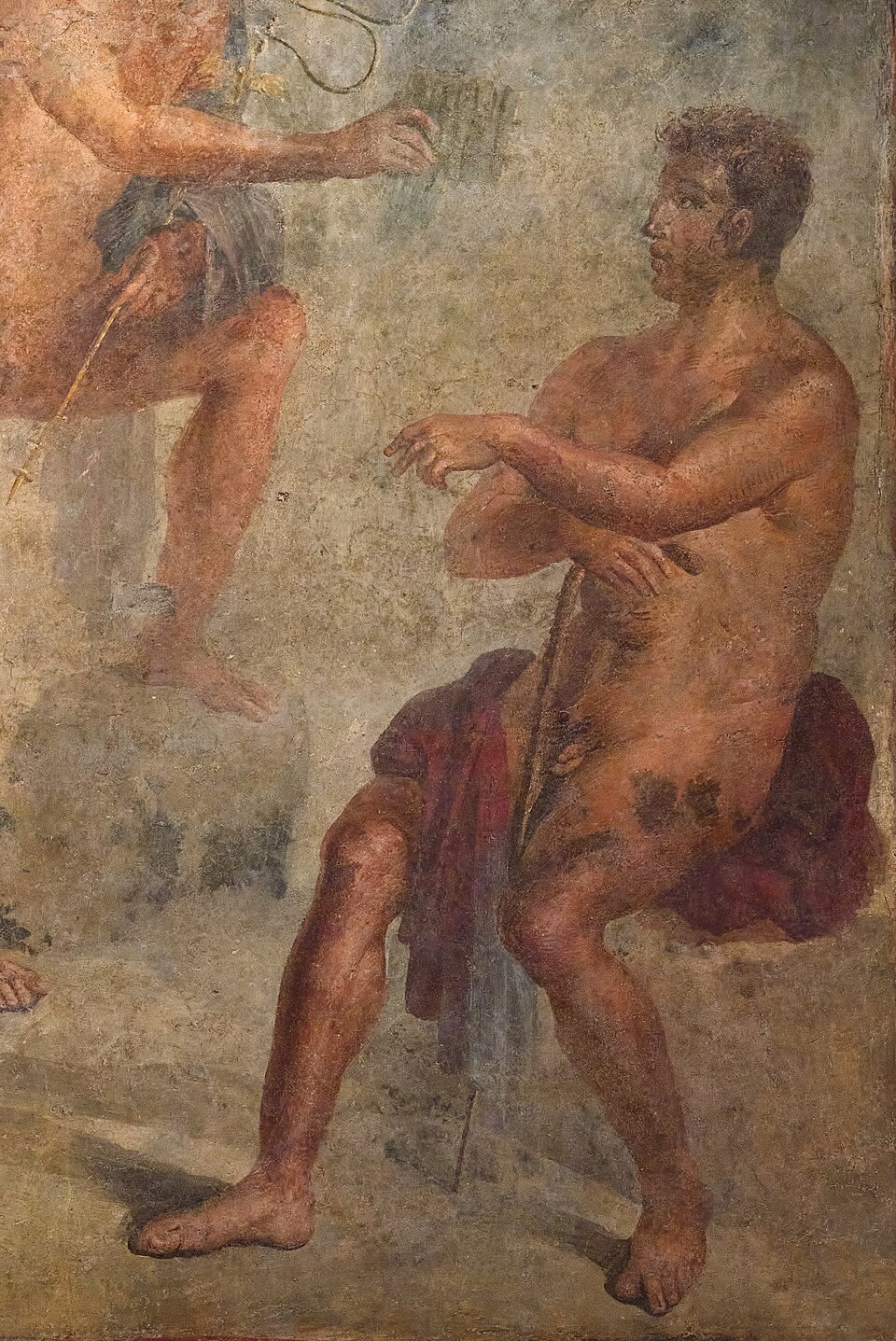
Argus's Power Ritual
Argus Panoptes, the All-Seeing One, Guardian of Io, Ordained by Hera, He of a Hundred Eyes
Learn more… Fehux10
 Ansuzx10
 Kenazx10
The Temple of Zeus and its Initiates welcome you to Our Assembly.
Be favorable to us,
For We Call you in Zeus's Name.
 Dagazx10Kenazx10Ansuzx10
The evil man who seeks injury to the Initiate is observed.
The good man who seeks to benefit the Initiate is observed.
Thus, Great Agares, you have said, "I will reward and reprimand them all accordingly!"
Nothing escapes you. No deed goes unrecorded. Your hundred eyes never close, and every one of them remembers.
 Algizx10
 Berkanox10Algizx10
In Both Your Aspects,
To Guard Io,
The Queen of the Light.
Thus, you have said, "As I have protected Io, so shall I protect the disciples who are Loyal to the Temple of Zeus, the House of the Gods, for Hera, my Queen, has Commanded this."
Kenazx10 Sowilox10Dagazx10
"Those who walk the Path of the Gods can See in Four Directions,
While the Regular People can see in only One Direction.
For only the Wise will be bestowed with some of my hundreds of Eyes!"
Dagazx10 Othalax10Dagazx10
You can see all,
You can hear all,
You can comprehend all,
You can see everything!
You have a hundred eyes that have seen a hundred aeons.
Sowilox10Berkanox10 Raidhox10
Blessed are you in the West, the South, the East, and the North!
Blessed are you with the Light of Zeus Eosforos,
With which you can see in the Aether Domain of Light and Darkness.
All-seeing are you, see us!
Blessed are you, and blessed are all Your Names and Attributes!
Blessed are we, by blessing You!
Your Vision is into the Light of Eosforos!
All-Seeing One,
Great Is Your Power!
After you are done with this, you can meditate on Argus's Sigil in the Temple of Zeus, or the one below. Let yourself be immersed and receive energy from Argus.
It's important to meditate on yourself after the Ritual calmly for a few minutes.
SAT
सत्: SAT, real, true, truthful in Sanskrit.
The Shen Ring
The Symbol that Encapsulates the Sigil: The Shen Ring, Egyptian Hieroglyphic language. The Shen also survived in Chinese tradition as a glyph for Spiritual Force, Divine Force, and God.
Letters of the Sigil
The Ancient Greek letters for Argus's Name in arrangement.
On Argus Panoptes
Argus Panoptes (Greek: Ἄργος Πανόπτης, "Argus the All-Seeing") is a primordial giant in Greek mythology, described as having a hundred eyes distributed across his body, of which only a few would sleep at any given time, making him the perfect guardian. Hera appointed him to watch over Io, the priestess whom Zeus had transformed into a heifer. Ovid (Metamorphoses I.622-723) provides the most detailed account: after Hermes slew Argus, Hera placed his eyes upon the tail of her sacred bird, the peacock, so that his vigilance would endure forever. The name Panoptes ("all-seeing") connects Argus to the concept of divine omniscience and spiritual clairvoyance. His "two aspects" referenced in the ritual correspond to his dual role: watching the external world for threats and watching the internal world of the Initiate for spiritual progress.
(Sources: Ovid, Metamorphoses I.622-723; Apollodorus, Bibliotheca II.1.3; Aeschylus, Prometheus Bound 567-574, Suppliants 303-305)
On Agares (Goetic #2)
The Goetia lists Agares as the second spirit: a Duke commanding 31 legions, appearing as an old man riding a crocodile and carrying a goshawk. His attributed powers (teaching all languages, causing earthquakes, making runaways return) correspond to the all-seeing, all-comprehending nature of Argus Panoptes. The crocodile is a Nilotic survival: the watchful reptile whose eyes sit above the water line, seeing all while appearing submerged, paralleling Argus's sleepless vigilance. The name Agares is a phonetic contraction of Argos/Argeas.
(Sources: Weyer, Pseudomonarchia Daemonum, 1577; Ars Goetia, 17th c.; Scot, The Discoverie of Witchcraft, 1584)